
Composite design always begins with an ideal intention: perfectly aligned plies, precise fiber angles, and a laminate that behaves exactly as expected in analysis. But as soon as reinforcement materials are applied to real, curved molds, reality introduces a new variable — draping. Unlike flat surfaces where plies remain unchanged, complex geometries force fabrics and prepregs to deform, especially through in-plane shear, which causes fibers to rotate from their theoretical layout
This deformation isn’t just a manufacturing concern — it has a direct influence on mechanical performance. A structure may be designed for a 0°/90° configuration but end up with significantly misaligned fibers in curved regions, reducing stiffness and strength. Draping simulation helps engineers catch these discrepancies early and integrate them into analysis, achieving far more reliable predictions.
Why Simulate Draping?
There are two major motivations behind performing draping simulation in ACP. First, it allows engineers to assess manufacturability. When shear exceeds the material’s physical capacity — often defined by a “locking angle” of roughly 30–40° — the fabric begins to resist further deformation, leading to wrinkling or material defects that degrade performance.
Identifying such regions early provides the opportunity to reposition the layup, adjust fiber orientations, or redesign mold geometry.
Second, ACP extracts the true final fiber orientations and automatically applies them to the finite element model for all downstream analysis.
This eliminates the usual disconnect between the “designed laminate” and the “manufactured laminate,” especially in highly curved structures such as automotive exterior panels, turbine blades, pressure housings, medical devices, and aerodynamic fairings.
The Internal Draping Algorithm: How ACP Models Reality
To perform draping simulation, ACP represents the reinforcement as a pin-joint net composed of small square or rectangular unit cells
Each cell contains two initially orthogonal fiber directions. As the ply settles on the surface, these fibers rotate, and the simulation determines the configuration that minimizes shear strain energy.
The process begins at a Seed Point, which acts as the physical location where a technician would first place the ply on the mold. From that point, the simulation progresses along a Draping Direction, then spreads over the surface in a controlled propagation pattern that reflects realistic material placement sequences.
Two internal material models allow ACP to reflect different manufacturing behaviors:
-
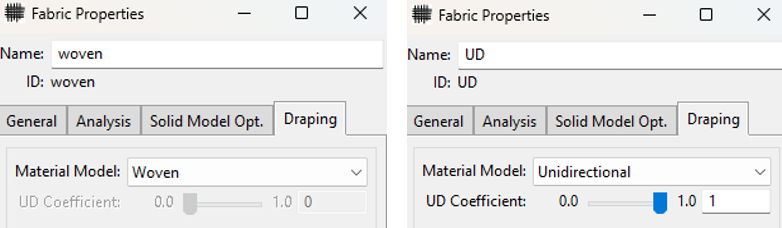
For woven fabrics, the model assumes fibers are stiff in length but free to rotate at crossover points, enabling distortion primarily through rotation rather than extension.
-
For unidirectional reinforcements, the model preserves fiber length in the primary direction but allows some compliance transverse to the fibers. A special parameter controls exactly how much freedom is permitted, making this approach useful even for stiffer UD tapes. A value of 1 indicates fully unidirectional behavior.
Based on this physical idealization, ACP progressively determines each new cell’s position until the entire draping area is covered — or flags zones where material conformity becomes impossible.
Design Insight Through Simulation Outputs
Once the algorithm completes, ACP provides several layers of information. The most intuitive visualization is the shear/distortion angle, expressed in degrees across the surface. A low angle means the final fiber rotation is small; high angles indicate potentially critical manufacturing regions nearing fabric locking limits
More importantly, ACP produces the final fiber direction vectors, which automatically replace the theoretical layup orientation in finite element evaluation — with no manual work required from the user. And because manufacturing needs don’t end with simulation, ACP also creates a flat pattern (flatwrap), which can be exported in standard formats such as DXF for material cutting and shop-floor integration
An optional Thickness Correction feature also exists. When a ply shears to follow a curved path, its area changes but its volume does not. The algorithm automatically adjusts the thickness accordingly so that structural properties remain physically consistent
How to Use Draping in an Engineering Workflow
ACP allows users to enable draping either globally, at the Oriented Selection Set level, or on individual plies for local control. When activated, the software requires a Seed Point and Draping Direction, although ACP can also automatically estimate a direction when none is provided.
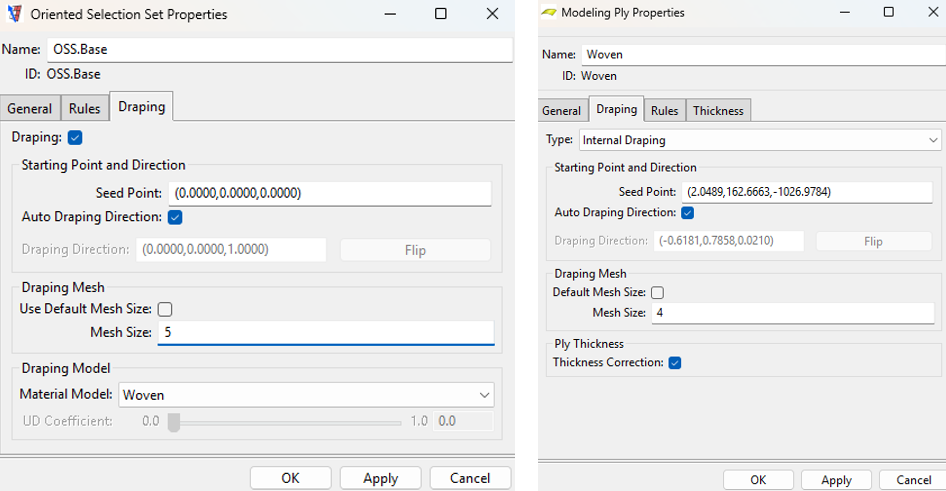
Choosing the Seed Point is especially significant: depending on where the ply first contacts the mold, the resulting shear pattern may shift dramatically. On a hemisphere, for example, beginning at the pole yields a very different result than starting from the equator — even if every other modeling choice remains unchanged.
The Draping Mesh also plays a large role. This mesh is completely independent from the structural mesh, which means engineers can refine the draping resolution without impacting FE analysis cost. If results appear incomplete or unrealistic, modifying the mesh size, adjusting seed location, or redefining propagation direction typically resolves the issue.
For cases where forming simulations are performed externally, ACP provides a User-Defined Draping interface allowing imported fiber direction corrections through tabulated data.
This ensures a consistent workflow between manufacturing simulation tools and structural analysis.
Current Limitations and Best Practices
Although the draping solution is powerful, it relies on realistic assumptions. Sharp edges and highly discontinuous geometry do not drape physically and can lead to flawed results unless the surface is subdivided into smoother sections
Additionally, the approach does not model fiber slippage, which only becomes relevant after locking occurs — a regime typically avoided in production anyway
Engineers should always review results visually and validate critical regions with physical prototypes or manufacturing feedback — especially when working close to the allowable shear limits.
Conclusion: Designing With Reality in Mind
Draping simulation in Ansys ACP closes one of the largest gaps in composite product development: the discrepancy between design intent and manufacturing outcome. By predicting material deformation on complex geometries, ACP empowers engineers to:
-
Reduce production risk
-
Improve structural prediction accuracy
-
Strengthen collaboration with the shop floor
-
Deliver high-performance composite structures without costly redesigns
In a world where weight, stiffness, and durability are mission-critical, this integration of manufacturing-aware modeling represents a decisive step forward.
Downloadable Resource
Related content
For more details, visit the Youtube video.
Ozen Engineering Expertise

Ozen Engineering Inc. leverages it's extensive consulting expertise in CFD, FEA, thermal, optics, photonics, and electromagnetic simulations to achieve exceptional results across various engineering projects, addressing complex challenges like multiphase flows, erosion modeling, and channel flows using Ansys software.
We provide expert consulting, mentoring, and training to optimize hydraulic and water control systems. Our team leverages advanced simulation tools like Ansys Fluent to deliver precise, reliable solutions for piezoelectric actuator design and analysis. For details, visit https://ozeninc.com.