
Engineering Design Iteration Challenges
Engineering design is inherently iterative. Achieving demanding performance, efficiency, and reliability targets requires continual refinement. Engineers are often tasked with optimizing complex geometries and flow environments, where even small shape modifications can deliver substantial gains—or introduce unexpected performance issues.
Traditional design workflows rely heavily on manual modifications and time-consuming CFD simulations, often leading to extended development timelines and increased resource consumption. The need for rapid, data-driven design changes without excessive computational overhead is a persistent challenge in industrial engineering environments.
CFD Design with Gradient-based Optimization
Gradient-based optimization, when paired with the adjoint solver, offers a step-change improvement in CFD-based design iteration. The adjoint solver in Ansys Fluent enables engineers to automatically determine the sensitivity of performance objectives (such as pressure drop, flow uniformity, or drag/lift) with respect to shape changes, reducing the number of simulations required for optimization.
By computing gradients for all design variables in a single solve, the adjoint method accelerates the optimization loop, provides clear guidance on which geometric changes matter most, and enables engineers to converge on superior designs with less trial and error. This approach is especially beneficial in industry applications, where reducing development cycles can significantly impact time-to-market and operational efficiency.
Adjoint Solver in Ansys Fluent
These are the main steps for the gradient-based optimization in Fluent
- Flow Setup
- The adjoint solver
- Optimize the design
- Design iterations
Flow Setup
We first need to set up the primary CFD simulation by establishing geometry, mesh, boundary conditions, and solving for the initial flow solution.
The adjoint solver
The adjoint problem is solved to calculate the sensitivity (gradient) of the objectives and determine where in the domain we need the design change (shape change). The steps for setting up the adoint solver in Fluent are listed below- Define an observable
- Gradient-based numerics setup
- Adjoint calculation
- Gradient-based post-processing

Optimize the Design
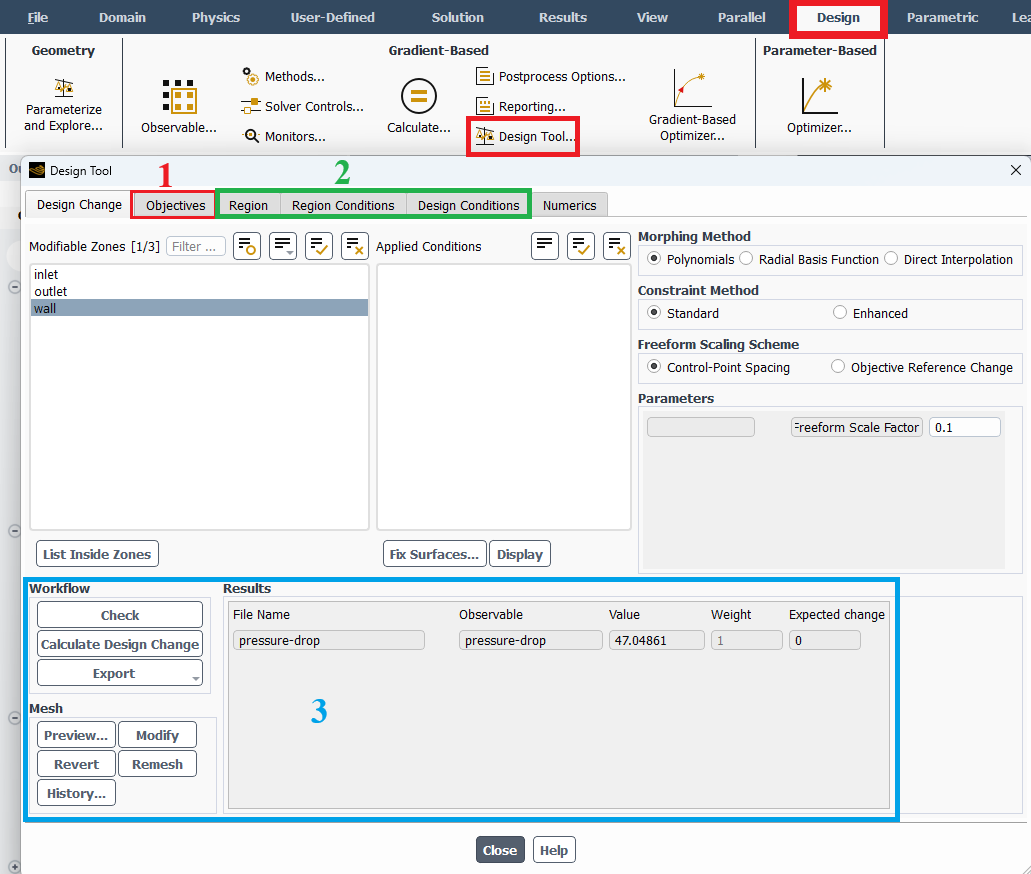
We used the Design Tool in Fluent to perform the design optimization.- Define the optimization objective: the objective function is called observables, such as reducing pressure drop, minimizing energy loss, and reducing drag force
- Specify the region for shape modification: choose where the design is allowed to change and impose geometric constraints where the shape change is not allowed. You can define region design conditions, such as control points to control shape changes in that region
- Calculate the design change and evaluate the adjoint results
Design Iterations
Fluent has a gradient-based Optimizer tool that automates the design-iteration process for shape optimization, allowing us to achieve a specified target objective without manually repeating each step for every design iteration.
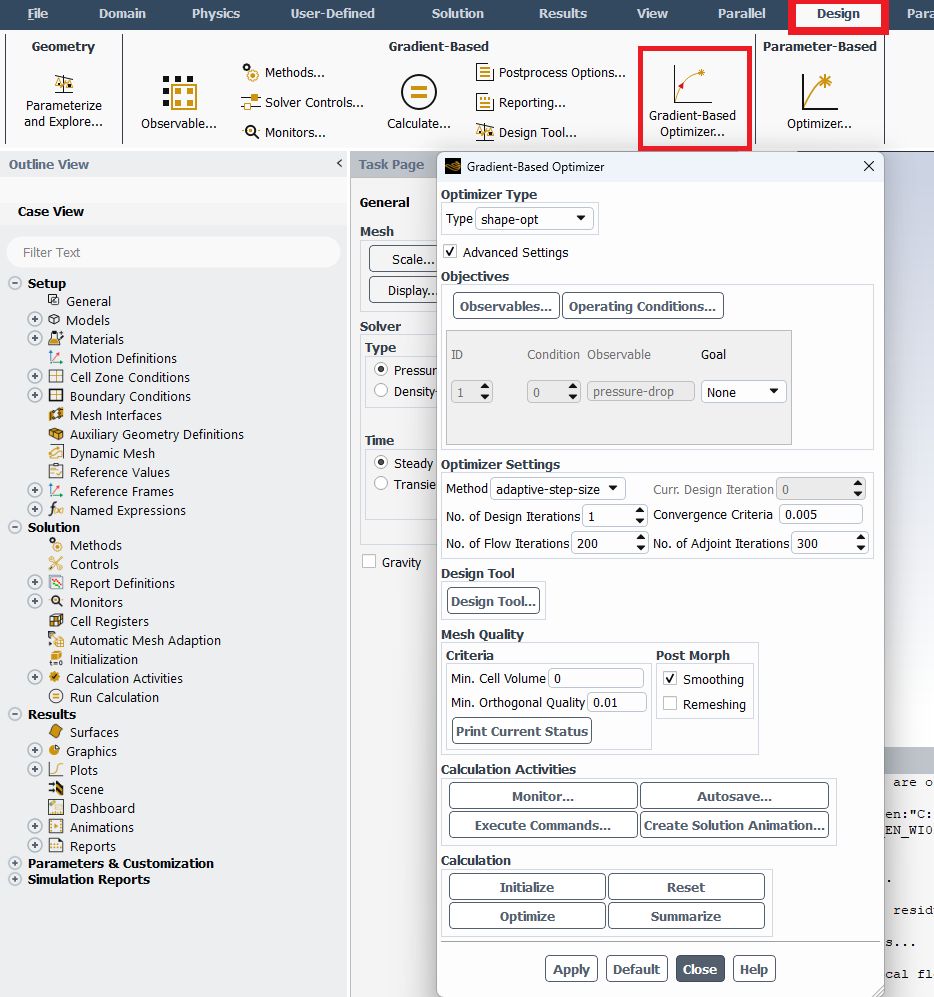
Fluent’s integrated workflow enables direct geometry modification based on these sensitivities, allowing engineers to iteratively morph the shape to meet target performance—without exporting to separate CAD or CFD tools. Final validation is then performed by running a full CFD solution on the optimized configuration, confirming the performance gains before committing to physical prototyping or production.
Optimizing a U-Bend Pipe to Reduce Pressure Drop
The gradient-based optimization and adjoint solver are used to modify the bend pipe shape for a reduction in pressure drop along the pipe from inlet to outlet. These three videos demonstrate the workflow
Video 1: Adjoint solver
Video 2: Optimize the pipe design
Video 3: Design iterations
Adjoint Solver Optimization in Industrial CFD Workflows
Engineers using the adjoint solver in Ansys Fluent should begin with a high‑quality mesh, a validated baseline CFD solution, and clear objective functions and constraints. They then apply Fluent’s shape morphing, automation, and sensitivity analyses to iterate quickly, identify key design drivers, and validate results with engineering judgment and experimental data to get robust, manufacturable designs. In mining, energy, and heavy equipment, embedding this adjoint workflow in existing simulation processes speeds design iteration, cuts physical prototyping costs, and delivers products optimized for real operating conditions while supporting collaboration, compliance, reliability, and operational performance.
Ozen Engineering Expertise

Ozen Engineering Inc. leverages its extensive consulting expertise in CFD, FEA, thermal, optics, photonics, and electromagnetic simulations to achieve exceptional results across various engineering projects, addressing complex challenges like stirred mixing systems using Ansys software.
We offer support, mentoring, and consulting services to enhance the performance and reliability of your systems. Trust our proven track record to accelerate projects, optimize performance, and deliver high-quality, cost-effective results for both new and existing stirred mixing systems. For more information, please visit https://ozeninc.com.